


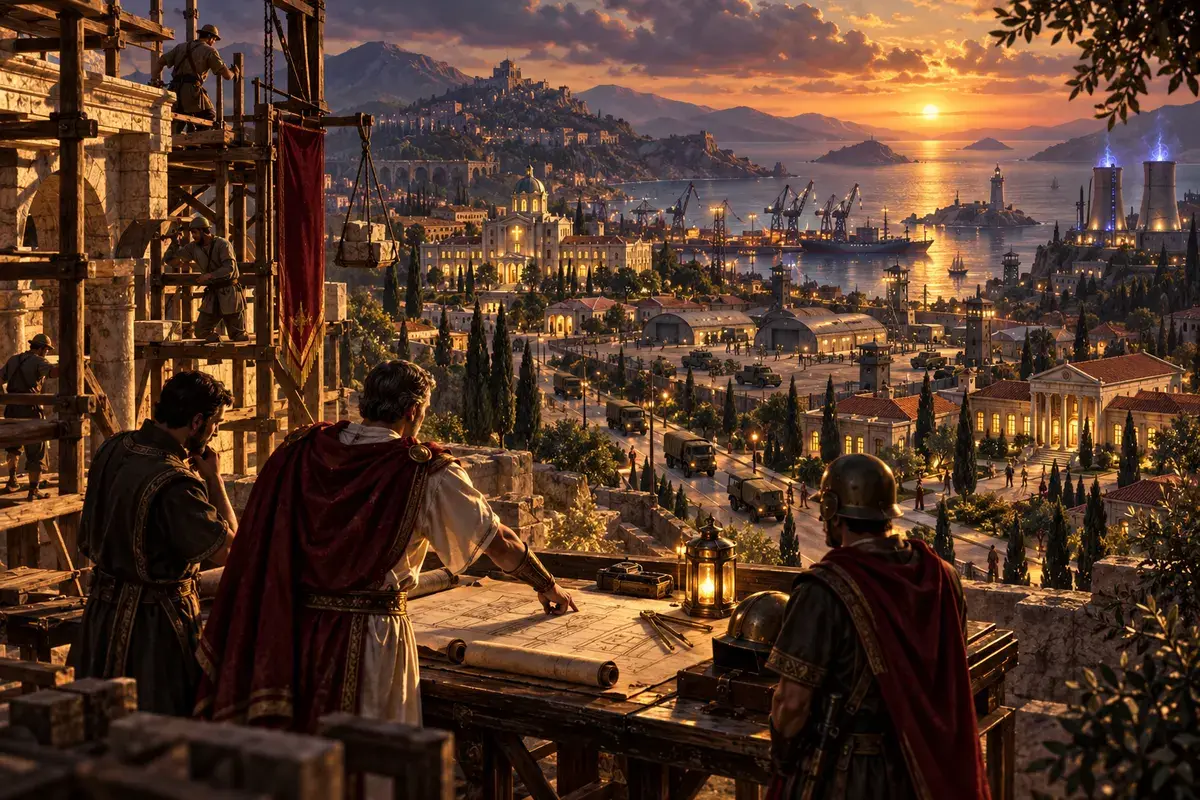
Seven building kinds can be built in a region: road, hospital, military base, school, missile system, sea port and boron power plant. A road raises CASH and material output in factories, a hospital raises natural energy refill, a military base raises land war damage and a school shortens skill training. A missile system in missile wars and a sea port in naval wars shift the attacker’s damage by the difference between the source and target regions; a sea port can only be built in a coastal region. The effect comes from the region’s index: 2% per index point, and 30% at index 11, which the strongest region holds. One boron power plant powers 4 buildings of its state; on a short grid buildings are not destroyed, their effect drops in proportion.
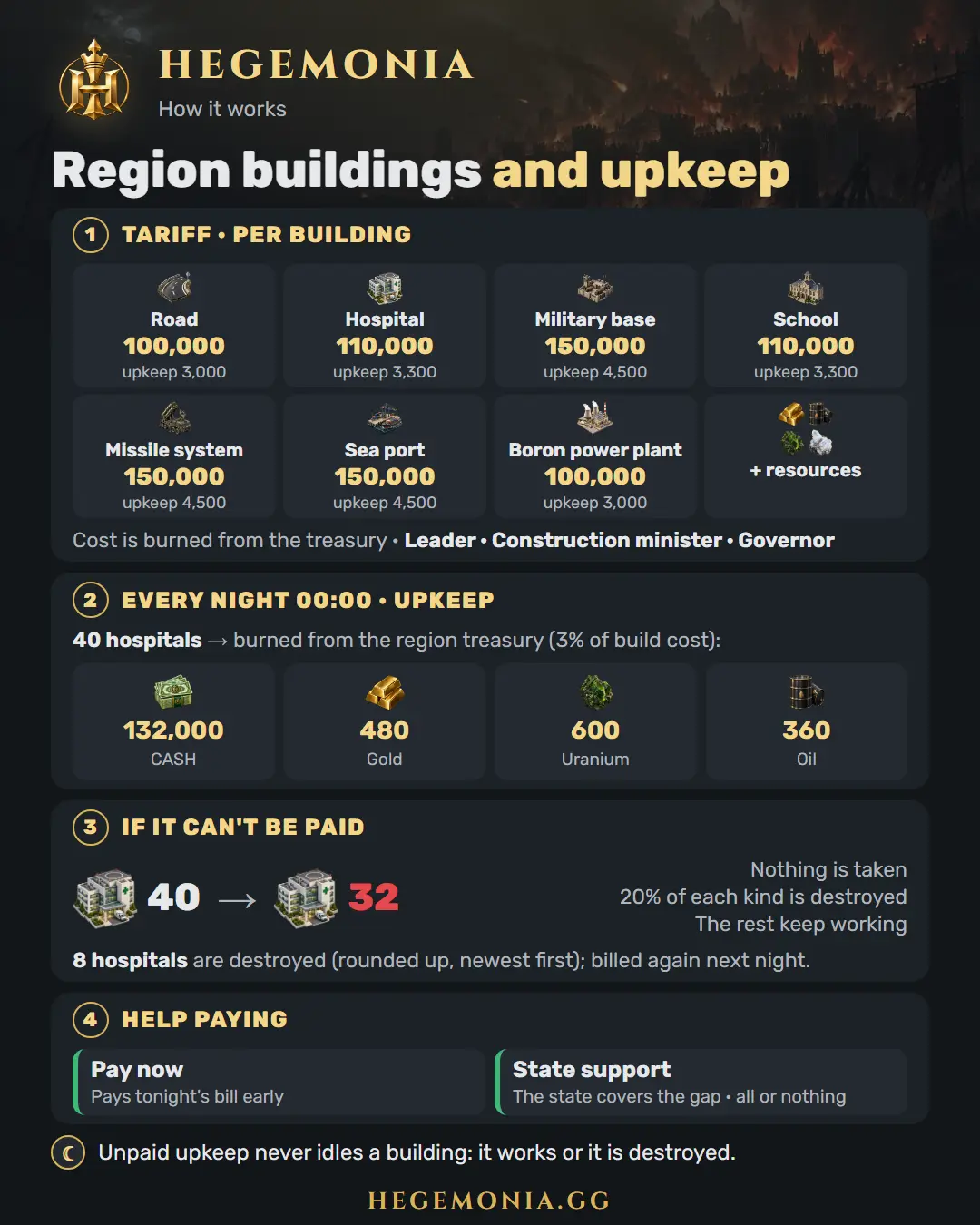
Build cost per building: road 100,000, hospital 110,000, military base 150,000, school 110,000, missile system 150,000, sea port 150,000, boron power plant 100,000 CASH, plus gold, oil, uranium or boron by kind. The leader or construction minister builds from the state treasury; the leader, construction minister or that region’s governor builds from the region treasury. One order builds 1–100 buildings, paid from the treasury.
Every night at 00:00 (Turkey time) 3% of each building’s build cost is taken from the region treasury and removed from the game. If the treasury falls short nothing is taken; 20% of every building kind in the region (rounded up) is demolished, newest buildings first. The rest keep working and are billed again the next night; there are no idle buildings. Example: upkeep for 40 hospitals is 132,000 CASH, 480 gold, 600 uranium and 360 oil; if unpaid, 8 hospitals are demolished and 32 remain.
The leader, construction minister or governor can pay the coming night’s upkeep early from the region treasury with Pay now. The state can cover a chosen region’s shortfall from the state treasury with a nightly cap per resource; support covers the whole shortfall or nothing. When a region is conquered its buildings are halved; see War rules.
 Energy and drinks
 War rules
 State, leadership and applications
 Factories and resources